
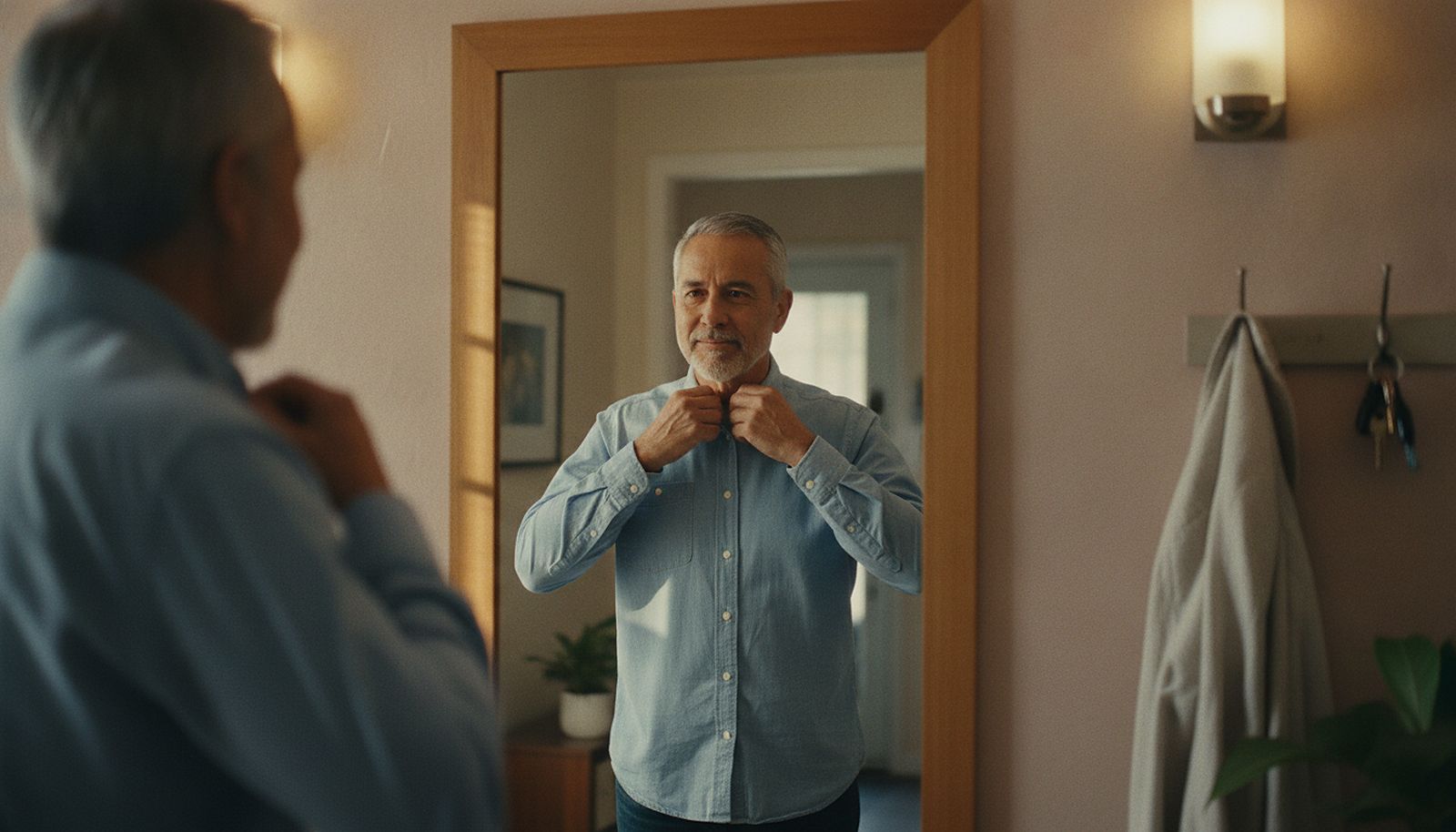
Dating in your 50s as a man comes with a piece of good news that almost nobody tells you: statistically, you’re in the better seat. Pew Research Center found that 57% of women over 50 described their online dating experience as negative — but only 38% of men said the same. Whatever the apps are doing to people, they’re doing less of it to us. I’m 61, widowed at 58, three years back in the field, and I can confirm the data with anecdotes.
But “better seat” is not “easy chair.” The same forces that make it workable — a huge pool, women who know what they want, no biological clock in the room — also punish laziness fast. This is a guide to the real terrain: the advantages, the traps, the mistakes I’ve made or watched friends make, and what actually works.
The reality: the benefits of dating in your 50s as a man — and the traps
Start with the advantages, because men our age chronically undercount them. The pool is enormous — nearly 3 in 10 adults in their 50s are single. The women in it are largely done with games: The Senior List’s late-2024 survey found mature singles know what they want, and that selectivity makes them more satisfied daters, not pickier ones. A man who shows up honest and prepared stands out immediately, because the bar set by his competition is on the floor.
And the Pew numbers matter psychologically. If your experience of the apps is “mediocre but tolerable,” understand that the average woman your age is having a worse time — fielding crude openers, fake profiles, and men who vanish. She’s not cold; she’s braced. Every bit of ordinary decency you show lands twice as hard against that backdrop.
Now the traps. The biggest is the mirage of infinite choice: swiping feels like abundance, so nothing gets real effort. The second is calibration — men who haven’t dated since 1995 either treat a first coffee like a marriage interview or like a job they can phone in. The third is bitterness leakage: one paragraph about your ex-wife or “women these days” and you’ve told her everything she needs to know, none of it good.
Three terms worth pinning down before we go further, because men our age keep tripping over them.
Age-appropriate range is the span of ages where you and a partner share the same life stage — established career, grown or nearly grown children, similar health horizon. For most men in their 50s that is roughly 45 to 65, not 25 to 40.
Intent signalling is stating plainly, in your profile and early messages, what you are actually looking for. It is the single cheapest filter available to you.
Slow fade means answering less and less until the other person stops writing, instead of saying you are not interested. It is common after 50 and it is still cowardice.
The mistakes men over 50 keep making
I keep an informal catalog from my own missteps and my friends’ post-date briefings. The pattern behind almost every entry is fear — of rejection, of aging, of being seen clearly. Here’s the honest map:
| The Pattern (from fear) | The Shift (from wisdom) |
|---|---|
| Photos from ten years and twenty pounds ago | Recent photos, honestly captioned — she’ll meet you anyway |
| Filtering for women 15 years younger | Matching people who share your decade and your references |
| Monologuing about career and grievances | Asking questions and actually following up on the answers |
| “Let’s grab a drink sometime” vagueness | A concrete plan: place, day, time |
| Playing it cool to avoid seeming eager | Saying plainly that you had a good time |
| Quitting after three bad dates | Treating it as a season, not a referendum on your worth |
Two of these deserve emphasis. The age-filter mistake is the most common and the most self-defeating: the men flooding 42-year-olds’ inboxes are invisible to the women most likely to actually want them. And the vagueness mistake is the most fixable. Women our age have decades of experience with men who “keep it casual” as a hedge. A specific invitation — Thursday, seven, that Basque place — is the cheapest possible way to look like a serious adult.
Margaret’s note: From the other side of the table: we can tell within ten minutes whether you researched nothing, and within twenty whether you’re still married to your anger. The men who get second dates aren’t the handsomest ones. They’re the ones who asked me a question I hadn’t been asked before, and who seemed pleased — not smug, pleased — to be there.
Your profile and photos, through a man’s eyes
Think of your profile as a signal-to-noise problem. She’s scanning fifty profiles that all say “love to laugh, live life to the fullest.” Your job is to be the one that sounds like a specific human being.
Photos first, because they are what she sees before she reads a word — they decide whether your profile gets opened at all. You need four to six: a clear, smiling head shot in daylight; a full-body shot (yes, really — hiding it reads as hiding something); one doing something you love; one with friends or family, faces cropped or blurred if needed. No sunglasses in every picture, no fish, no bathroom mirrors, no car selfies. Ask a woman friend to pick the final set — her eye is calibrated to your audience and yours is not.
Text second. Three short paragraphs beat one wall. Say what your days actually look like, name two or three genuinely specific things — “restoring a ’74 CB550” outperforms “motorcycles” — and say clearly what you’re looking for. If you want a real relationship, write that. Pew found about half of over-50 app users are seeking long-term partners; declaring it filters in exactly the people you want. Skip the negatives entirely: “no drama, no games” is itself a red flag in her reading, and she’s usually right.
Where to actually meet women over 50
The apps work, but they’re a lane, not the highway. Use both.

Online: Match remains the most popular platform among the 50-plus crowd per Pew’s research, which matters because you want to fish where the fish are. General apps with a serious-intent skew beat niche “senior” sites in most metro areas. Keep your radius honest and your age range honest, message like a person (“I noticed you hike the coast trail — which stretch?”), and move to a phone call within a week or so. Voices filter faster than texts.
Offline: The principle is repeated, low-stakes exposure. Anything that meets weekly beats anything that meets once: hiking groups, community college classes, volunteer crews, church or civic groups, pickleball (I resisted; I was wrong), dance classes where men are permanently scarce. You’re not there to hunt — that’s palpable and repellent — you’re there to become a familiar, pleasant presence. Familiarity is the most underrated attraction mechanism for our demographic.
Also: tell your friends you’re looking. It feels old-fashioned. It’s also how a remarkable share of over-50 couples I know actually met. A warm introduction skips three weeks of vetting.
A word on geography and logistics, because they matter more at 55 than they did at 30. Most women our age have anchored lives — a house, grandkids nearby, a job with roots — and so, probably, do you. A match ninety minutes away is a real cost, not a rounding error, and pretending otherwise usually just postpones an honest conversation. Set your search radius to a distance you’d genuinely drive on a rainy Tuesday in February, and you’ll waste far less of everyone’s time.
Pace, initiative, and who does what
Here’s the rhythm that works, in my experience and my friends’: move from matching to messaging within a day or two, to a call within a week, to a first meeting within two. Momentum matters — long pen-pal phases build fantasies that first meetings can only puncture.
You may run into the “3-3-3 rule” — roughly three days of messaging before a call, three weeks before the exclusivity conversation becomes fair, three months before judging real compatibility. As law it’s silly; as rhythm it’s about right. Its real value is diagnostic: if you keep blowing past those markers in either direction — proposing exclusivity on date two, or texting someone for two months without meeting — the rule isn’t what’s broken.
On initiative: at our age, take it, cheerfully and without keeping score. Plan the first date somewhere quiet enough to talk. Confirm the day before. Pay for the first one graciously and negotiate the rest like adults. Follow up within a day if you’re interested; say a kind, clear no if you’re not. None of this is about gender politics — it’s that ambiguity is the tax everyone hates paying, and you can simply choose not to charge it.
Then let the pace breathe. A woman in her 50s may need more time than you before physical intimacy, exclusivity, or meeting her kids, and pressing the tempo reads as need, not desire. The paradox of dating at 50 as a man is that low urgency plus high effort is the most attractive combination there is — and the rarest. For what the first hour itself should look like, our first date tips for over 50 covers the details, and it helps enormously to understand what the women across the table are dealing with — read that one even though it isn’t addressed to you. Especially because it isn’t.
My own re-entry was not smooth. Eight months after I decided I was “ready,” I took a woman to dinner in Davis — nice restaurant, good conversation — and spent forty minutes of it, by her later account, describing my late wife’s garden. She was gracious. She also, correctly, declined a second date, and in her kind little note she wrote: “Tom, you’re lovely, and you’re not done yet.” I was furious for a day and grateful ever since. I spent that winter actually grieving instead of dating around it. The next spring, dates stopped feeling like séances. Readiness isn’t a decision; it’s a condition — and other people can see it before you can.
If you’re a widower, read this part slowly
Widowers tend to re-enter dating earlier than widows, and there’s no shame in that — loneliness after a good marriage is its own testimony to the marriage. But the timeline that matters isn’t the calendar; it’s whether a new woman gets to be herself, or has to compete with a memory. You’ll know you’re ready when you can mention your wife with warmth and then genuinely return your attention to the person in front of you. If every conversation bends back toward the past, that’s not a flaw — it’s just grief still doing its work, and it deserves its own room. We’ve written a gentler, fuller guide for exactly this passage in starting over, and I’d start there before starting anywhere else.
How old should a man in his 50s date? The honest math
The honest answer: date within roughly a decade of your own age, because that’s where mutual interest, shared references, and actual relationships live — not because anyone says you must.
Let me do the math nobody wants done. Yes, some 55-year-old men date women of 35. Those men typically bring something scarce to that market, know exactly what the arrangement is, and accept its costs. If that’s not recognizably you, the “next one will be 35” plan mostly produces an empty inbox: your messages land in the most crowded inboxes on the platform, competing against both younger men and the handful of older men those women actually choose. Meanwhile the women most likely to genuinely want you — 48 to 62, roughly — never see you, because your filters excluded them.
There’s a subtler cost too. A woman your own age remembers the same music, gets the same jokes, and is heading into the same decades you are. That’s not settling; that’s compatibility, the thing you’re allegedly searching for. A twenty-year gap means different energy levels, different life stages, and eventually different caretaking realities — manageable for some couples, but a real price, not a detail.
My working rule: set your search range to your age minus ten through your age plus five, then judge individuals, not birthdays. The gap conversations are worth having honestly — we cover the reverse case in do younger women like older men, including when it’s real and when it’s a script.
Health, energy, and the bedroom: what to expect
Expect your body at 55 to be a different dating partner than it was at 35 — and expect that to matter far less than the ads for testosterone clinics want you to believe.
The practical realities, stated plainly because nobody else will:
- Energy budgets are real. Two dates in a weekend plus a hike is a younger man’s itinerary. Plan quality over quantity and nobody will ever notice the difference.
- Erectile changes are close to universal. Slower arousal, less reliability, medication side effects — this is the ordinary physiology of our decade, not a verdict. See a doctor, not a supplement ad: it’s usually treatable, and it’s sometimes an early flag for cardiovascular issues worth catching anyway.
- Her body changed too. Menopause is not a mystery you’re excused from understanding. A man who can hear “I need more time” or “things work differently now” without sulking is rarer than he should be.
- The conversation beats the performance. The couples who do well aren’t the ones with the youngest bodies — they’re the ones who can talk about all this in complete sentences, even laugh about it.
Honesty helps more than bravado at every step. If intimacy is on the horizon, say what’s true about your health and ask about hers. For the fuller picture of how couples our age actually handle this, older couples and sexuality goes into the detail this section can’t.
The bottom line
Dating in your 50s as a man is a genuinely good hand played badly by most of the men holding it. The numbers favor you, the women are more honest than the folklore claims, and the bar for standing out is embarrassingly low: recent photos, real questions, concrete plans, kindness, and clarity about what you want. Skip the games you never liked anyway, date people who share your decade, and treat effort as the whole strategy — because at this age, it is. The rest of our dating after 50 guides can take it from here.
A note on where this comes from: I’m Tom Reyes, 61, widowed at 58, three years back in the field. The specifics here are mine and my friends’, not a study of anyone. Where I quote a number rather than an experience, it links to the research it came from — the full list is on our sources page, and our editorial policy sets out what we will and will not treat as evidence. Corrections welcome: contact us.