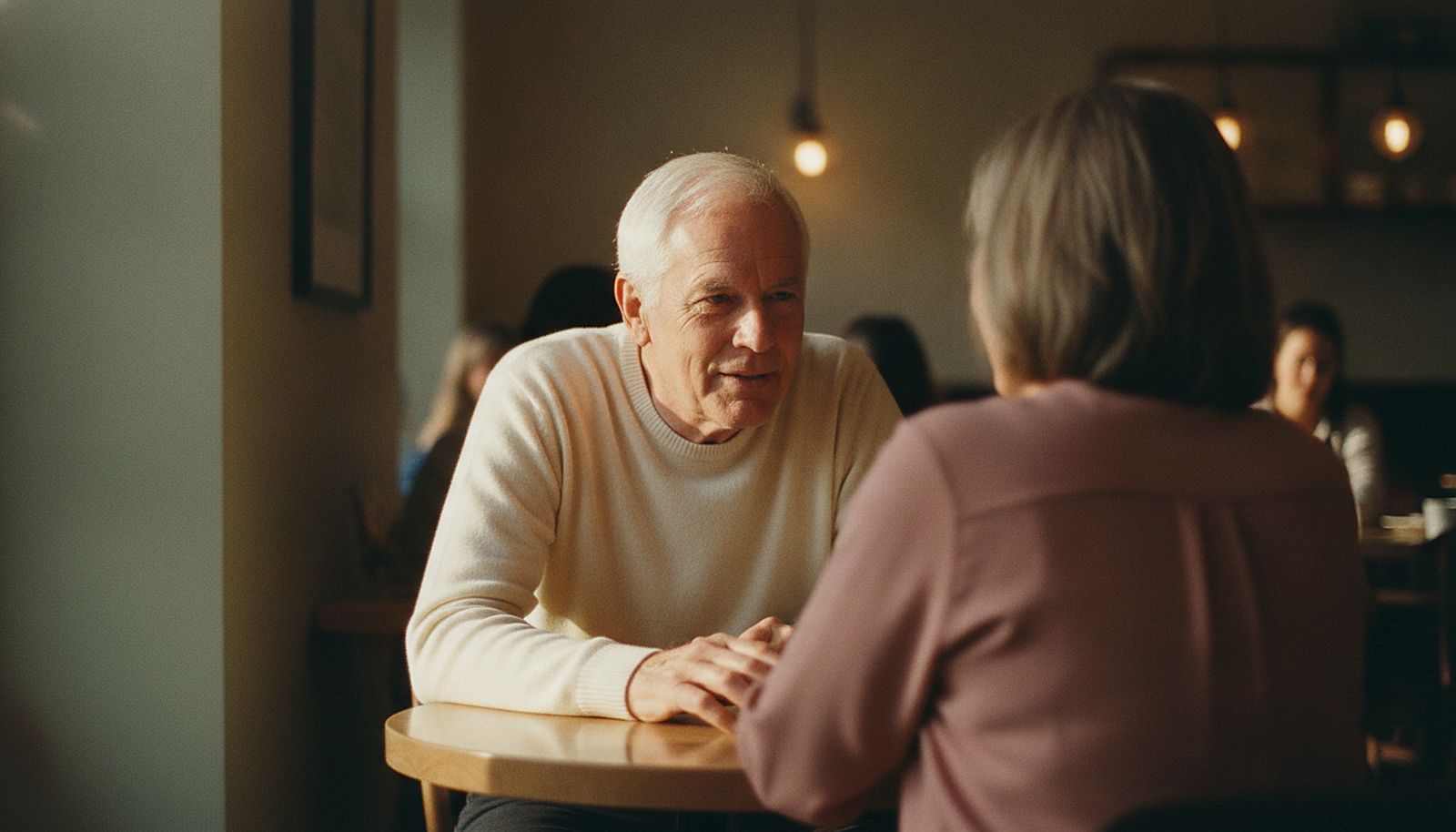
What Do Men in Their 50s Want in a Woman? An Honest 2026 Answer
What do men in their 50s want in a woman? Peace, kindness, and a partner with her own life — a 61-year-old widower answers without the usual clichés.
Can you find love after 50? Yes — and not as a lottery win, but as a normal, common outcome for people who go looking. Nearly 3 in 10 adults in their 50s are single, and research consistently shows most of them who date are serious about finding a real partner. Love in the second half of life tends to be quieter than the first-round version: less fireworks-and-panic, more recognition. That is not a downgrade. Ask anyone who has both.
This hub is about the feelings side of it all — the part the how-to guides skip. What falling in love actually feels like at 55 or 65, how to tell interest from politeness, and how to be honest with yourself about whether you are lonely, ready, or both. Margaret and Tom write from inside the question: one rebuilt after divorce, one after loss, and both found that the capacity for love did not go anywhere.
Yes, you can find love after 50, and the odds are far better than most people assume. With nearly 3 in 10 American adults in their 50s single and roughly half of older app users seeking a long-term partner, the math is on your side. The people who succeed are not younger-looking or luckier — they are simply active, visible, and willing to go on actual dates.
One finding worth holding onto: a 2024 Senior List survey found that mature singles who stay selective report higher satisfaction with their dating lives. Standards are not the obstacle. Invisibility is. Keep your standards, raise your activity, and the odds move steadily in your favor.
Falling in love after 50 feels different mainly in tempo and clarity: the attraction is just as real, but it comes with less panic and far less self-invention. You are not performing a future self for anyone — you are showing someone a finished house rather than a set of blueprints. That makes late-in-life love faster to recognize and slower to destabilize.
The other change is what you value. Chemistry still matters, but reliability, humor, and how someone treats a waiter start carrying the weight that abs and ambition carried at 30. People often describe second-act love as being seen rather than being swept away. Both are wonderful. Only one lasts.
After 50, interest looks like effort, not fireworks. A man or woman who is genuinely interested initiates contact without prompting, remembers details you mentioned once, makes concrete plans instead of vague someday-talk, and introduces you to the people who matter to them. Consistency over weeks is the single strongest signal — far stronger than intensity in the first days.
The flip side: grown adults who like you do not make you decode them. If you find yourself building a case from crumbs — a late-night text here, a warm moment followed by a week of silence — that is the answer. Mixed signals at this age are a clear signal, politely delivered.
Loneliness and readiness feel similar from the inside, but they lead to very different relationships. Loneliness wants anyone; readiness wants someone. A useful test: if the thought of a quiet weekend alone feels unbearable rather than merely unexciting, some of the pull toward dating may be escape — and escape makes for poor partner selection.
The fix is not to postpone dating until you are perfectly healed; nobody is. It is to build a life that works solo — friends, routines, things you look forward to — while you date. Paradoxically, the less desperately you need a partner, the better the partners you attract. That is not a cliché; it is selection pressure.
Good, if you are active. Nearly 3 in 10 adults in their 50s are single, and Pew finds about half of older dating-app users want a long-term partner. The strongest predictor is not age or looks but behavior: people who date consistently and use several ways of meeting typically find a serious match within one to two years.
Of course — the capacity for romantic love does not expire at any age, and research on later-life couples shows the bonds formed are just as deep, often more stable. What changes is the flavor: less anxious infatuation, more clear-eyed attachment. Many women describe love at 50-plus as the first time it felt genuinely peaceful.
No. Fifty puts you in the middle of one of the largest dating populations in the country — nearly 3 in 10 adults in their 50s are single, most of them serious. Nobody in that pool thinks you are too old, because they are your age too. The only real disqualifier is deciding in advance that it is pointless.
Through effort and consistency rather than grand gestures: he initiates calls and plans, remembers small things you said, shows up on time, asks real questions, and gradually folds you into his life — friends, family, routines. An interested man over 50 makes his interest unambiguous. Sustained ambiguity is itself an answer.
Several forces stack up: divorce after long marriages, widowhood, women outliving men, and — importantly — choice. Many women in their 50s are single because they will no longer settle for a mediocre relationship, not because nobody wants them. That selectivity is healthy; surveys link it to higher satisfaction, not worse outcomes.
It is a legitimate choice, not a consolation prize — plenty of people over 60 build rich, connected single lives. But 'better' depends on what you want. If you genuinely miss partnership, age is a poor reason to abstain: people form loving relationships in their 60s, 70s, and beyond routinely. Wanting it is reason enough to try.