

Do younger women like older guys? Yes — some do, genuinely, and not as a favor. But before you take that as a green light, understand what the yes actually contains. Younger women who date older men are drawn to steadiness, self-possession, and the rare experience of being fully listened to. They are not drawn to age itself. Nobody is. Age is the wrapping paper; what’s inside either holds up or it doesn’t.
I’m 61, a widower since 58, and I’ve been on both ends of this question — asked it, and been the subject of it. I’ll give you the straight version, because the internet’s version is mostly written by people selling something.
The honest answer: yes, but not for the internet’s reasons
Search this question and you’ll find two camps shouting past each other. Camp one: “younger women are biologically wired to want providers” — usually followed by a course you can buy. Camp two: “any younger woman with an older man is after his money.” Both camps are describing transactions. Neither is describing a relationship.
Here’s what I’ve actually observed, in my own dating life and among friends: when a younger woman likes an older man, she likes that man. His steadiness. His lack of panic. The fact that dinner with him doesn’t involve checking his phone or decoding mixed signals. The age difference is a fact about the relationship, not the engine of it.
The distinction matters because it cuts both ways. If you’re an older man hoping your age itself is an asset — that showing up with gray hair and a paid-off car does the work — you’ve misread the market. Your age opens no doors. What you did with your years might.
And the numbers say most of us are playing a longer game anyway. Pew Research found that around half of dating app users over 50 are looking for a long-term partner — and Match remains the most popular platform for our age group. That’s the context for this whole question: not conquest, partnership.
What actually attracts younger women to older men
Three things come up over and over, from women themselves rather than from marketers.
Stability — but the internal kind. Yes, an established career and a settled life are attractive. But the stability that matters most is emotional: a man who doesn’t spiral, doesn’t sulk, doesn’t turn a disagreement into a week of silence. Many women describe dating age-peers as managing a second adolescence. A man who has already had his crises and learned from them is offering something scarce.
Confidence without performance. By 55 or 60, a man either knows who he is or has run out of excuses. The attractive version isn’t loud. It’s the quiet kind: comfortable ordering at a restaurant, comfortable saying “I don’t know,” comfortable letting her be impressive without needing to top it. Insecure confidence — the lecturing, name-dropping variety — reads as older and weaker, which is the worst available combination.
Listening. Genuinely. This one is embarrassingly consistent. Women report that older men who date well share one trait: they ask questions and remember the answers. That’s it. That’s the secret the courses sell for $499. Somewhere in your fifties you stop rehearsing your reply while the other person talks — and it turns out that was most of what anyone wanted. It’s the same skill that decides everything else about what men in their 50s want in a woman, just pointed the other direction.
Notice the pattern: all three are earned traits, not birthdays. A 58-year-old who never developed them has no age advantage over anyone.
Three definitions that make the rest of this argument possible.
A stated preference is what someone reports wanting on a survey or a dating profile. A revealed preference is who they actually message, date, and marry. The two routinely disagree, and the second one is the data that matters.
Age-gap dating here means a difference of roughly ten years or more; below that, most couples are simply in the same life stage.
When it’s a red flag — on both sides
Time for the uncomfortable section. Age-gap attraction is legitimate; certain patterns inside it are not. Check yourself against the first list and her against the second.
Red flags on his side:
- He only dates much-younger women. A preference for a person is human. A hard filter that excludes every woman with shared history and equal footing is usually a filter against being challenged.
- He needs the authority role — teacher, rescuer, sponsor. If the relationship stops working the moment she doesn’t need him, it was never a relationship. It was a job.
- He hides her from his peers, or hides his peers from her. Both mean he knows something is off and prefers not to hear it said aloud.
- He’s rebuilding self-esteem on her youth. After a divorce or a loss, a much-younger partner can function as proof you’ve still got it. That’s a use, not a bond, and she will eventually feel the difference.
Red flags on her side:
- The relationship accelerates whenever money appears and cools whenever it doesn’t.
- She keeps him compartmentalized — no friends, no family, no daylight.
- She wants the older man more than she wants him: the category, the aesthetic, the story it makes. Being someone’s type is fine. Being someone’s prop is not.
The clean test for both parties is substitution: if another person of the same age and means could be swapped in without much loss, someone is dating a category. Categories always disappoint, because eventually a person shows up.
“She’s attracted to me” is not “we’re compatible”
This is where I watch men my age drive off the cliff, so slow down for it. Attraction is a spark; compatibility is a climate. A younger woman can be genuinely, sincerely drawn to you and you can still be wrong for each other in every way that decides the next twenty years.
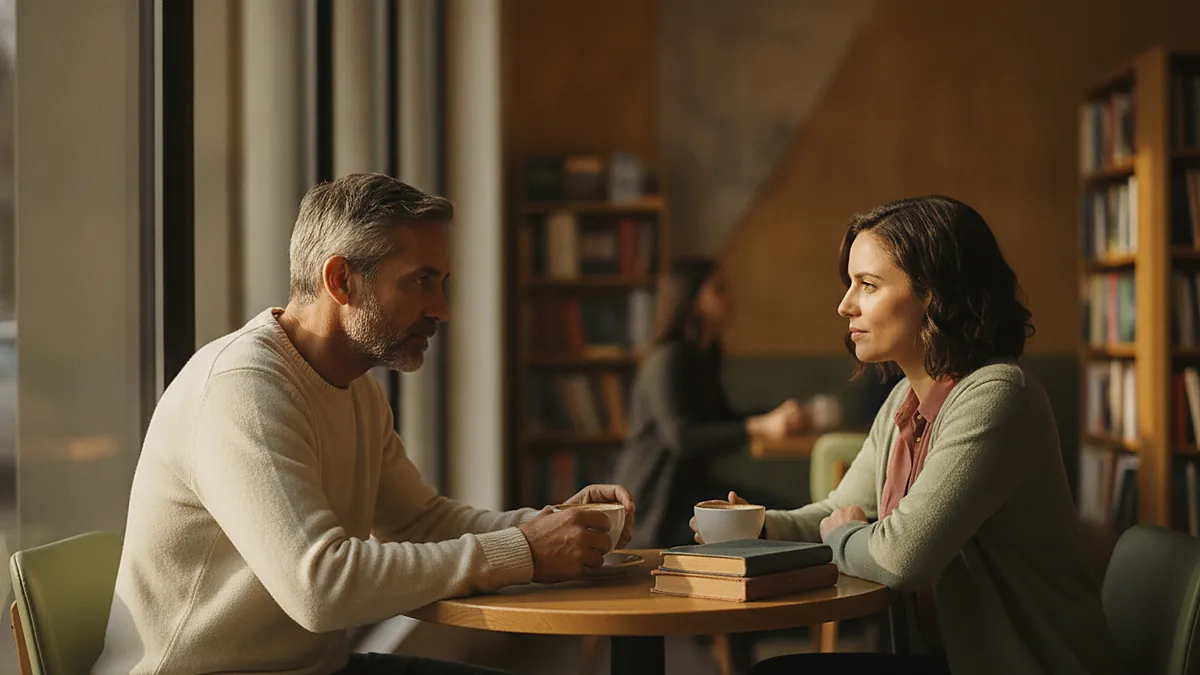
Run the boring questions, because the boring questions are the real ones. Does she want children — and what’s your honest answer at 61? When she’s 45 and mid-career, you may be 70; who is living where, and how? Do your friends mix, or do you live in alternating worlds? When the novelty of the gap fades — and it fades for both of you — is there a Tuesday-night life you both actually want?
One more compatibility check that gets skipped: pace of life. At 61 my ideal Saturday involves a long walk, a hardware store, and being asleep by ten-thirty. Hers might involve three social events and a flight. Neither schedule is wrong, but a couple runs on one clock, and somebody has to name whose. The gap in energy is negotiable; the silence about it isn’t. I’ve watched more age-gap couples wear out over calendars than over anything as dramatic as money or family.
And be honest about the friendship test. If you can’t picture her bored on your couch on a rainy Sunday — not entertained, not entertaining, just comfortably bored next to you — you’re describing a romance, not a life. Romances are fine. Just don’t sign a life’s paperwork on one.
Selectivity is the theme of dating at this age, and it should be. A survey by The Senior List in late 2024 found that mature singles know what they want, and that this selectivity tracks with satisfaction. Apply that selectivity here hardest of all: the flattering match is not automatically the right one. If you want a structured way to pressure-test your own readiness and motives, take the quiz — it asks the questions your ego won’t.
| The Pattern (from fear) | The Shift (from wisdom) |
|---|---|
| Chasing youth to outrun aging | Choosing a person, whatever her birth year |
| Performing wealth and status on dates | Offering steadiness and attention instead |
| Filtering out all women your own age | Filtering for character at every age |
| Avoiding the kids-and-timeline talk | Raising it yourself, early and plainly |
| Needing to be the teacher in the room | Enjoying being surprised by her |
| Treating her interest as a verdict on you | Treating compatibility as the real question |
The ethics: power, money, and keeping the scales level
An age gap isn’t unethical. Pretending the gap carries no weight is where the trouble starts. If you’re 60 and she’s 34, you likely hold more money, more professional leverage, and more relationship experience. None of that makes you a villain. All of it makes you responsible for how the weight gets used.
Some working rules, learned by observation and one or two bruises:
- Never trade on dependency. If her housing, job, visa, or finances run through you, the relationship can’t breathe honestly. Keep those channels separate or don’t proceed.
- Make disagreement cheap. She should be able to tell you you’re wrong without cost. If your seniority ends arguments, you don’t have a partner — you have staff.
- Do the actuarial math out loud, once. She may spend her sixties as your caregiver. Say it plainly, let her answer plainly, and respect the answer. One honest conversation beats a decade of both of you not mentioning it.
- Mind the mentor drift. Advice is generous; a curriculum is control. If you’re steering her career, her friendships, and her taste in wine, you’re not partnering — you’re programming.
The only time I tried dating notably younger — she was 39, I was 60, we met in the waiting room of a physical therapist in Tucson, both nursing bad shoulders — I made a quiet mistake that took me weeks to spot. I kept paying for everything, planning everything, smoothing everything, and congratulated myself on being generous. Over enchiladas one night she said, “You know I had a whole life before this, right? You keep managing me like a project.” She wasn’t angry. She was accurate, which is worse. We parted friends, and I kept the lesson: what I’d called generosity was really control with better manners, and my late wife would have caught it in a day.
Margaret’s note: From the other side of the table — what makes younger women roll their eyes isn’t an older man’s interest, it’s his assumptions. The men who succeed treat her as a full adult with a history, not a fresh start with none. And gentlemen: she can tell within one dinner whether you like her or the way she makes you feel about yourself. We all can. It’s the first thing we check.
What the research actually says about age preferences
The research on age preferences comes down to one consistent finding: what people say they want and what they actually do are two different data sets. In stated-preference studies the pattern repeats with almost boring reliability: across 37 samples in 33 countries, David Buss found men reporting a preference for younger partners and women for older ones. Evolutionary psychologists have built careers explaining why. But what people say on a survey and what moves them in a room are different things — Eastwick and Finkel found that stated ideals failed to predict who participants actually wanted after meeting them face to face.
But behavior tells a humbler story. When researchers look at who people actually message, date, and marry — not who they claim to want — the vast majority pair up close to their own age — Pew puts the average spousal age gap at 2.2 years, down from 4.9 in 1880. Large gaps are the exception, a small minority of couples, not a hidden mainstream. The stated preference is a wish list; the behavior is the purchase history. They rarely match, in dating or anywhere else.
There’s also the “why older men” literature the tabloids love — attachment styles, father figures, the security hypothesis. Some of it is interesting; much of it is speculation dressed up in citations. I’d hold it loosely. In my experience, a 30-something woman dating a 60-year-old doesn’t need an evolutionary explanation any more than any other couple does. She met a person she liked.
So read the science as context, not permission. It says your situation is uncommon and comprehensible. It doesn’t say it’s owed to you.
Signs a younger woman is genuinely interested — and signs she isn’t
A younger woman who’s genuinely interested treats you like a person she’s discovering, not a role she’s cast — and that difference shows up in observable behavior within a few dates. Watch for these, in both directions.
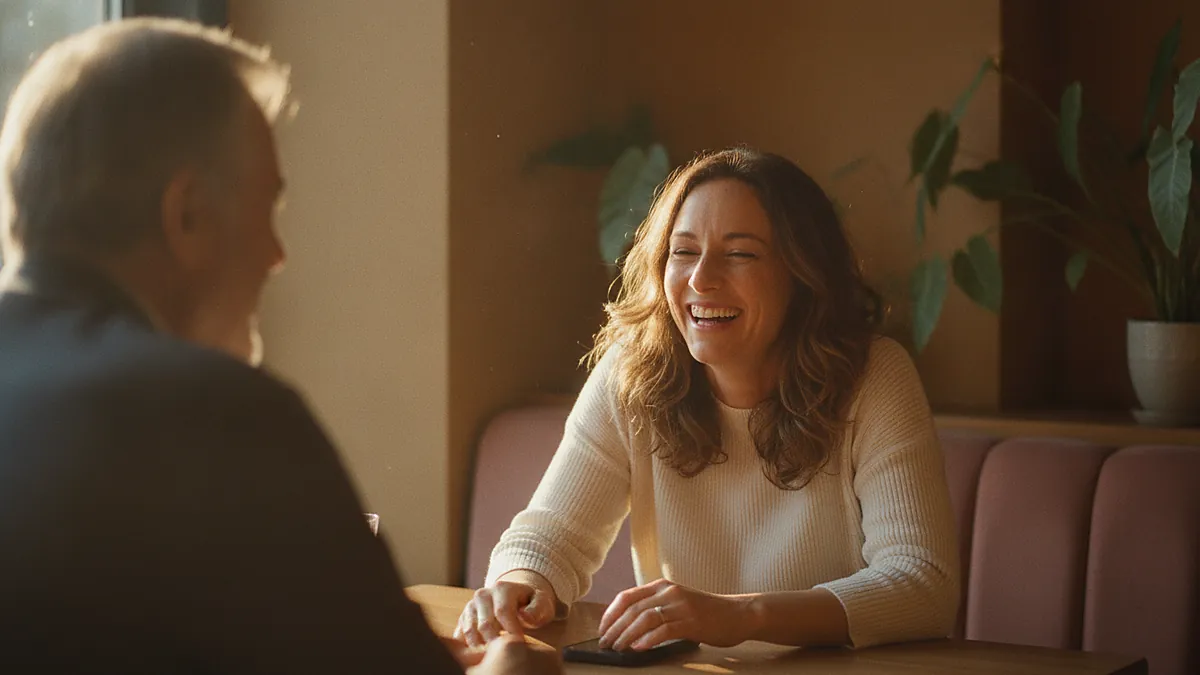
Signs it’s real: she initiates — texts first, suggests plans, doesn’t leave the entire logistics of the relationship to you. She asks about your life beyond your career and your assets: your friends, your bad decade, what you were like at her age. She remembers details and builds on them. She’s happy doing unglamorous things — a hardware store run, a Tuesday soup night — not just occasions with a dress code. And she brings you into her world: her friends meet you, and she wants to meet yours.
Signs it isn’t: her warmth tracks your spending with suspicious precision — attentive when plans are expensive, distant when they’re ordinary. You exist in a compartment: no friends, no family, no photographs. Every conversation orbits her needs, with your role limited to solving them. Or she talks about “older men” as a category a little too fondly — which means you’re an aesthetic, and aesthetics get replaced.
None of these signs is a verdict on its own; patterns are what count. Give it six or eight ordinary dates — not grand ones — and the truth will organize itself in front of you. Ordinary time is the most honest lie detector there is.
The bottom line
Do younger women like older guys? Some do — specifically the older guys who spent their years becoming steady, curious, and worth listening to, and who want a partner rather than a prize. Age opens no doors by itself; character opens most of them at any age. If a particular younger woman likes the particular man you are, take it seriously and have the honest conversations early. If you’re chasing the category, stop and look at what you’re actually running from — the answer is usually in the mirror, not on the apps. And whatever the age on her profile, the fundamentals of dating in your 50s as a man don’t change: show up honest, listen more than you talk, and let the rest be arithmetic. More on the whole territory at our age-gap hub.
The demographic figures here are drawn from Pew’s Census analysis; we keep them, dated and linked, in our statistics roundup and name every study on the sources page. For the same question with the ages reversed, read Margaret on older women dating younger men.
I’m Tom Reyes, 61, widowed at 58. The judgements here are mine; the research is cited so you can check it against me. Every study we lean on is listed on our sources page, and our editorial policy sets out how we read one before citing it. Found an error? contact us.