


Most first date tips for over 50 are written by people who haven’t been on one since college, which is how you end up with advice like “just be confident!” — thank you, very helpful. We’ve been on these dates. Margaret re-entered dating at 53 after a 27-year marriage; Tom started over at 58 after losing his wife. Between us we’ve sat through the great ones, the fine ones, and the one where a man brought printed spreadsheets (Margaret’s; long story). This is the guide we wish someone had handed us: what to do before the date, where to go, what to talk about, what to avoid, how to read the signals — and yes, the kissing question gets its own section, because everyone asks and nobody answers it straight.
One reframe before the tactics: a first date over 50 is not an audition. It’s ninety minutes of finding out whether you’d enjoy a second ninety minutes. That’s the whole job. Everything below gets easier once you accept how small the stakes actually are.
Before the date: preparation without the panic spiral
The goal of preparation is to lower the temperature, not raise the stakes. Three things actually help:
- Prepare questions, not a pitch. Write down two or three things you’re genuinely curious about from their profile or your messages. Curiosity is the most attractive quality on a first date and the easiest one to fake your way into feeling.
- Wear something you’ve worn before. A first date is the wrong night to debut new shoes or an outfit you need to keep adjusting. You want clothes you forget about within five minutes.
- Decide your exit time in advance. Tell yourself — and ideally a friend — that you’ll be home by a certain hour. Knowing the evening has a frame makes the whole thing lighter, and telling a friend where you are is basic safety, not paranoia.
And one thing to skip: the pre-date deep investigation. A quick check that they’re a real person is sensible. Reading three years of their Facebook is not — you’ll arrive with a script for a person you haven’t actually met.
If nerves are the real obstacle, remember the numbers are on your side. A late-2024 survey by The Senior List found that mature singles know what they want, and that selectivity tracks with satisfaction. Your pickiness isn’t a liability. It’s the skill this decade of dating rewards.
| The Pattern (from fear) | The Shift (from wisdom) |
|---|---|
| Treating the date as a test you might fail | Treating it as ninety minutes of information-gathering |
| Rehearsing answers to imagined questions | Preparing two genuine questions and letting the rest happen |
| Booking a two-hour dinner to seem serious | Booking coffee, so a good date can be extended and a bad one can end |
| Performing an upgraded version of yourself | Showing up as the person who’d actually be in the relationship |
| Ignoring discomfort to seem easygoing | Trusting the gut you’ve spent five decades calibrating |
Two definitions worth having before you go, plus one number worth carrying.
A first date after 50 is a short, low-stakes meeting whose only job is to find out whether you want a second one. Treating it as an audition for a marriage is what makes it unbearable.
The exit line is a prepared, kind sentence that ends the meeting without negotiation — “This has been nice, but I don’t think we’re a match.” Having one ready is what lets you relax.
And the number: nearly 3 in 10 adults in their 50s are single, according to Bowling Green State University’s analysis of 2022 Census data. Whatever this date turns out to be, it is not your last chance.
Where and what: why coffee beats dinner every time
The best first date ideas for over 50 share three traits: short by default, easy to talk in, and easy to leave. That points to two winners.

Coffee. Sixty to ninety minutes, daylight, cheap, quiet enough to hear each other. If it’s going well, “should we get a second cup?” extends it naturally. If it isn’t, you’re out the price of a latte and one hour of your life.
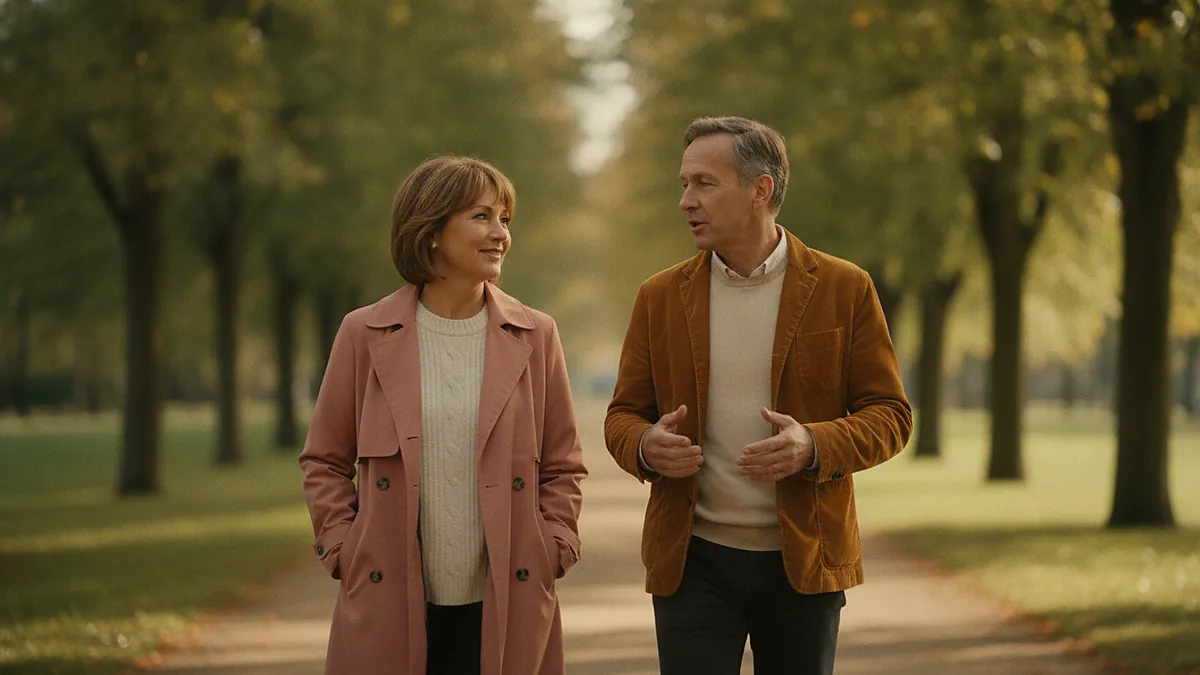
A walk. A park, a waterfront, a farmers market. Walking side by side takes the pressure off eye contact, gives you things to comment on, and has a natural endpoint. It’s especially good for people who find across-the-table interviews stiff — which, after 50, is most of us.
Why not dinner? Dinner is a commitment device: ninety minutes minimum, no graceful exit, and a check that introduces money dynamics before you’ve established anything else. Save it for date two or three, when you already know you like talking to this person. The same logic rules out movies (can’t talk), family events (obviously), and anything requiring a drive to a second location with a near-stranger.
Meet there, in public, with your own transportation. That’s not cynicism; it’s just how everyone sensible does it now, and a good match will expect nothing else.
What to talk about — and the three topics to ration
Good first-date conversation after 50 is simple: present and future, lightly seasoned with past. What fills your weeks now, what you’re reading, where you’d travel next, what made you laugh recently, what you’re curious about in them. You’re listening for energy and kindness, not auditing a résumé.
Three topics deserve strict rations — not because they’re shameful, but because they’re too heavy for a first coffee:
- Exes. A one-sentence summary is fine and expected: “Divorced four years ago; we’re on decent terms.” A narrated grievance tour is not. If either of you can’t mention the past without heat, that heat is information.
- Health. At our age everyone has a file. A passing mention is human; a full medical history recital turns the date into intake paperwork. There will be time for all of it — later, when it’s earned.
- Finances. Nothing kills a first date like a net-worth probe or a hard-luck money story. Anyone steering the first conversation toward your assets, retirement accounts, or their debts is telling you something. Believe them.
The test for any topic: does it open the conversation up, or close it down? Stories open. Complaints close. And the golden ratio is roughly half talking, half listening — if you can’t remember the last question they asked you, you already have your answer about them.
He says — Tom: Gentlemen, the single most common mistake I hear about from women is men who deliver a ninety-minute monologue and call it chemistry. Ask questions. Then ask a follow-up about her answer — that second question is the one that proves you were listening. Also: put the phone away, face down is not away, and pick up the check for coffee without making it a ceremony.
She says — Margaret: Ladies, our most common mistake is the opposite: interviewing for husband instead of noticing the human across the table. You do not need to determine his life-partner viability by the second cup. You need to answer one question: did I feel like myself around him? I once wrote off a lovely man for a slow first date and only learned on the do-over date that his nerves were the whole problem. Feeling at ease is the data. Everything else can wait.
Green lights and red flags: what the first meeting actually tells you
A first date over 50 is a small sample, but it’s not a blank one. Here’s what to weigh.
Signals of a real “yes”:
- Time moves faster than you expected, and one of you says so.
- They ask follow-up questions — proof of listening, not just waiting to talk.
- They mention a concrete future in passing: “You’d like that trail I walk.”
- You catch yourself being unguarded — joking, disagreeing lightly, telling the true version of a story instead of the polished one.
- The goodbye lingers. Nobody quite initiates leaving.
Red flags worth trusting:
- Rudeness to the server. This is a preview of year three, offered free of charge on day one.
- Nonstop bitterness about an ex — or about “all women” or “all men.” You’re auditioning for a role in someone else’s grudge.
- Pressure: to extend the date, to go somewhere private, to escalate physically, to “not be so cautious.” Pace-pushing on date one never improves with time.
- Vagueness about basics — where they live, work, their actual situation. Privacy is normal; fog is not.
- Any mention of money problems or, worse, any request. This is the classic setup for romance fraud, and it works because kind people give benefit of the doubt.
Context matters for the small stuff: nerves make good people talk too much, blank on names, and knock over a water glass (Tom did; the date still went fine). Judge patterns, not moments. But when a pattern shows up, believe it the first time — that’s the discipline. Pew Research found that 57% of women over 50 described their online dating experience as negative, versus 38% of men, and much of that gap traces to exactly these behaviors going unnamed. You are allowed to end a date early. “This has been nice, but I don’t think we’re a match” is a complete sentence, and using it is a skill worth having — one of several we cover across the dating skills hub.
When to kiss: the honest answer for dating over 50
Here’s the question everyone types into a search bar and no one asks their friends: dating over 50, when to kiss?
The honest answer: there is no schedule, and anyone selling you one is guessing. Some couples kiss on date one and marry two years later. Some don’t kiss until date four and do the same. After 50, the old choreography is gone — which is unnerving, and also freeing, because the only rule left is the real one: both people have to want it.
How to tell the moment is right:
- The goodbye stretches. You’ve said “well, this was lovely” twice and neither of you has moved toward the car.
- Distance has closed all evening — the lean across the table, the touch on the arm, walking shoulder to shoulder.
- Eye contact holds a beat longer than conversation requires, and nobody looks away flustered.
If the signals are there and you’re still unsure, ask. “I’d really like to kiss you goodnight” is not unromantic — delivered warmly, it’s one of the most quietly confident moves available, and it hands the other person a graceful yes or no. Compare that to the ambush lunge, which has ruined more promising first dates than bad conversation ever did.
Tom here. My first first-date kiss in thirty-six years happened in a parking lot outside a diner in Tucson, and I nearly talked myself out of it twice while pretending to look for my keys. We’d stretched a one-hour breakfast into three, and she was standing by her car not leaving, which even a rusty man recognizes eventually. My mistake was assuming there was a modern protocol I didn’t know — some app-era rulebook everyone else had read. So I finally just said, “I’d like to kiss you, if that’s agreeable,” which sounded like a man negotiating a lease. She laughed at the phrasing and said yes anyway. The lesson stuck: the words don’t have to be smooth, they just have to be honest and leave room for a no.
If the answer is a cheek, a hug, or “not yet” — that is not a rejection of you. Plenty of people over 50, especially those recently out of long marriages or bereavement, want more time before physical anything. A cheerful “no rush” costs nothing and says everything about you. And if you’re wondering what comes further down that road, our honest guide to intimacy and older couples sexuality picks up where this section politely stops.
Dates two and three: the questions that actually matter
You had a good first date. Now what?
Follow up within a day. A short, specific text: “I enjoyed the walk — you were right about the pie. I’d like to see you again.” Games belong to a decade neither of you lives in anymore.
Date two: change the setting. If date one was coffee, make date two dinner or an activity. You’re testing whether the ease travels — some connections only work in one format, and it’s better to learn that now.
Date three is where the 3-3-3 rule earns its keep: roughly three dates to see potential, a reassessment around three weeks, another around three months. Not science — just a guard against both panic-quitting after one flat evening and drifting for months on autopilot.
By date three, you’ve earned real third date questions — woven into conversation, not delivered across a clipboard:
- “What does a good ordinary Saturday look like for you?” (Daily-life compatibility beats vacation compatibility.)
- “What are you hoping the next five years look like?” (Working, moving, grandkids, travel — direction matters at this age.)
- “What did your last relationship teach you?” (One reflective answer tells you more than the entire history would.)
- “How do you deal with it when you’re upset with someone?” (Conflict style is destiny.)
- “What are you actually looking for?” (By date three, this is fair, and the answer should be roughly compatible with yours.)
If you’re not sure what your answer to that last one is, take ten minutes with our readiness quiz before someone asks you across a table. And since men and women often read these early dates differently, Margaret’s companion piece on dating over 50 as a woman covers the view from her side of the table in full.
What to wear on a first date over 50
The right thing to wear on a first date over 50 is something you already own, have been complimented in, and can forget about five minutes after sitting down — clean, current, comfortable, and one small notch above your everyday. That single rule outranks every style guide, because the job of the clothes is to free you up to be present, not to make an argument on your behalf.
A few specifics from each side of the table.
From Margaret, for the women: pick the outfit two days early and wear it around the house for twenty minutes — sitting, standing, reaching for a coffee cup. Anything you tug at fails the audition. Choose a color near your face that you genuinely like, skip brand-new shoes (a walk may break out), and keep jewelry at conversation level, not armor level.
From Tom, for the men: clean and well-fitting beats expensive every time. A collared shirt or a decent sweater over dark jeans or chinos covers nearly every coffee or walking date in America. Iron the shirt. Check the shoes — women notice them, gentlemen, it’s not a myth. And go very light on the cologne; the goal is that she finds it, not that it finds her.
Finally, dress for the venue you actually booked, not an imagined fancier one: coffee and a walk mean smart casual, full stop. Overdressing reads as pressure, underdressing reads as indifference, and something you’ve worn happily before reads as exactly what it is — a person at ease.
The five-minute safety checklist before you go
Before any first date over 50, run this five-minute checklist: know their full name, tell a friend where you’re going and with whom, get there in your own car or ride, meet in a public place, and keep your phone charged and on you. None of this is paranoia — it’s the standard procedure every sensible dater now follows, and a good match will be doing the same on their end.
The full list:
- Full name, verified. A two-minute search to confirm they exist as described. You’re not investigating; you’re confirming.
- One friend knows the plan. Who, where, when you expect to be home — and a quick “all good” text afterward.
- Your own transportation, both ways. No pickups at your home on date one, however gallant the offer.
- Public place, stay public. Any push to relocate somewhere private is one of the red flags covered earlier, not a compliment.
- Guard the practical things. Keep your drink in sight, your bag with you, and your home address to yourself for now.
Five minutes, and then you’re free to stop thinking about it — which is the point. Safety measures aren’t a mood-killer; they’re what lets you relax into the evening. For the longer version, including how romance scams actually operate, see the full safety section in our dating after 50 guide.
The bottom line
A first date after 50 is ninety minutes of finding out whether you want another ninety minutes — nothing more, and treating it as more is what makes it hard. Keep it short and public, trade curiosity instead of résumés, ration the exes-health-money triad, and trust patterns over single moments. Kiss when you both clearly want to, and ask when you’re not sure. You’ve had five decades of learning to read people; a coffee date is well within your qualifications.
The survey figures quoted here sit alongside the rest of our data in the statistics roundup; how we choose and read a study is explained on our sources page. Our editorial policy sets out what we accept as evidence, and both editors — Margaret and Tom — review these guides; if something here is wrong, contact us.