

Let’s start with the thing nobody says at dinner parties: older couples sexuality is one of the most quietly worried-about topics in midlife, and one of the least honestly discussed. If you’ve wondered whether what’s happening in your relationship — more desire, less desire, different desire, no desire — is normal, the answer is almost certainly yes. The range of what’s normal after 50 is enormous. Bodies change, timing changes, and the definition of intimacy itself often widens. What doesn’t have to change is closeness. This article is about what actually shifts after 50, what stays the same, and how to talk about all of it with the person next to you.
One thing up front: I’m not a doctor, and neither is Tom. Nothing here is medical advice. Where your body is involved, your physician is the right expert — and later in this article I’ll tell you exactly when it’s worth making that appointment.
What’s actually “normal” after 50? (The range is huge)
Here is the honest answer: normal after 50 runs from couples who are more sexually active than they were at 40, to couples who have warm, affectionate, essentially nonsexual relationships and are perfectly content. Both ends of that spectrum are real, and so is everything in between.
The problem is that almost nobody talks about it, so everyone quietly assumes they’re the outlier. The couple having sex twice a week thinks they’re strange. The couple who hasn’t in six months thinks they’re broken. Neither is true on the face of it.
What matters is not where you fall on the frequency chart. It’s whether the two of you are roughly content with where you are — or at least honest about the gap. A mismatch in desire is a conversation, not a diagnosis. Silence about the mismatch is usually the actual problem.
There’s a practical reason this matters more now than it did for our parents. Nearly 3 in 10 adults in their 50s are single, which means an enormous number of people are navigating these questions not in a 30-year marriage but with someone new — often for the first time in decades. The shape of later life has changed underneath us: among adults 65 and older the divorced share nearly tripled between 1990 and 2022, while the widowed share fell from 35.3% to 20.9%. More of us arrive here by choice than by loss, and that changes the conversation. The old scripts don’t cover that. We have to write new ones.
Some plain definitions first, because the clinical language around this is doing nobody any favours.
Responsive desire means arousal that arrives after intimacy begins rather than before it. It becomes the more common pattern with age and is not a loss of interest.
Genitourinary syndrome of menopause refers to the tissue changes — dryness, thinning, discomfort — that follow the drop in oestrogen. It is treatable, and it is not a verdict on your sex life.
Intimacy, in this article, means the whole territory of physical closeness: touch, warmth, being wanted. Intercourse is one part of it, not the definition of it.
What really changes after 50 — and what doesn’t
Let’s be specific, because vagueness is where anxiety lives.
What commonly changes:
- Pace. Arousal takes longer, for both men and women. What was automatic at 30 becomes intentional at 60. This is physiology, not a verdict on your attractiveness.
- Hormones. Menopause changes lubrication and sometimes comfort. Testosterone declines change erections and drive. These are common and, importantly, often manageable — with a doctor, not a search engine.
- Spontaneity. Many older couples find that “whenever the mood strikes” becomes “when we make room for it.” Planned intimacy sounds unromantic until you realize that anticipation is its own pleasure.
- Energy and medication. Blood pressure medication, antidepressants, and plain fatigue all have effects. Again: doctor territory, and worth raising.
What usually doesn’t change:
- The wish to be wanted. That doesn’t retire.
- The pleasure of touch, which if anything matters more.
- The link between emotional closeness and physical desire — which typically gets stronger with age, not weaker.
And here’s the part that surprises people: several things often get better. A survey by The Senior List in late 2024 found that mature singles know what they want — and that selectivity tracks with satisfaction. The same clarity applies inside the bedroom. By 50, most of us have stopped performing and started noticing. Less pretending is not a small upgrade.
| The Pattern (from fear) | The Shift (from wisdom) |
|---|---|
| Avoiding intimacy so you never have to discuss what’s changed | Naming the change out loud once, so it stops being a secret |
| Measuring yourselves against how things were at 35 | Measuring against whether you both feel close now |
| Treating slower arousal as failure and rushing past it | Treating slower as an invitation to take your time |
| Assuming your partner’s lower desire means rejection | Asking what’s actually going on before writing the story yourself |
| Googling symptoms at midnight and saying nothing | Booking the doctor’s appointment and mentioning it at dinner |
Intimacy is not just sex (and after 50, that’s good news)
If you take one idea from this article, take this: intimacy and intercourse are not synonyms. They never were, but after 50 the difference becomes useful instead of theoretical.
Physical intimacy for older couples includes the hand on the back in the kitchen, sleeping close, the six-second kiss that isn’t going anywhere, sitting thigh-to-thigh on the sofa instead of in separate chairs. None of that is a consolation prize. Touch is a language, and couples who keep speaking it stay connected even through stretches when sex is off the table — illness, grief, recovery, plain exhaustion.
This matters because the biggest risk after 50 isn’t less sex. It’s the slow withdrawal that sometimes follows it: one partner pulls back from all touch because they’re afraid affection will be read as an invitation they can’t follow through on. Then the other partner feels abandoned, assumes the worst, and pulls back too. Two people who love each other end up on opposite sides of a king bed, each convinced the other stopped wanting them.
The fix is almost embarrassingly simple: say it. “I still want to be close to you, even on nights when that’s all it is.” One sentence, and the cold war ends.
The winter after my divorce was finalized, I was 54 and convinced that part of my life was simply over — filed away with the wedding china. Then, about a year into dating again, I was sitting in a car outside a restaurant in Asheville with a man I liked, and he reached over and just held my hand while we finished talking. Not a move. Just warmth. I remember thinking: oh — I’ve been so busy dreading the question of sex that I forgot this part existed. My mistake for a whole year had been treating intimacy as a single door I was afraid to open, when it’s actually a hallway of small doors. That night I opened the easiest one, and the rest stopped feeling like a cliff.
How to actually talk to your partner about it
This is the section people skip, and it’s the only one that changes anything. A few ground rules that work:
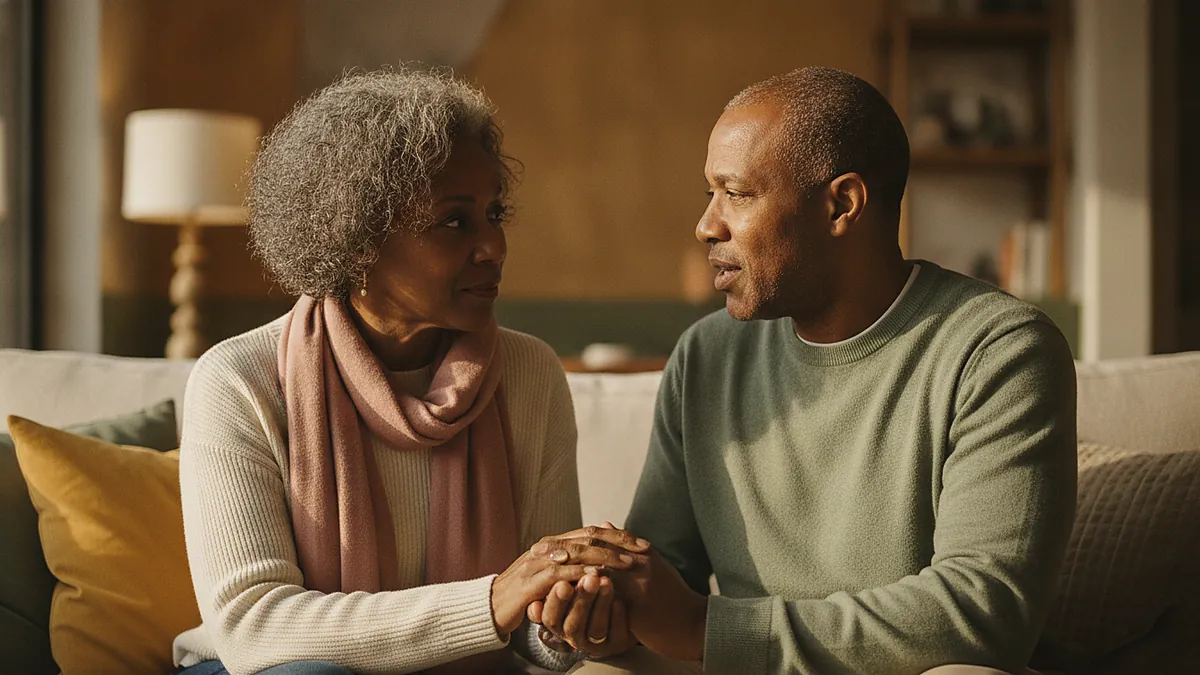
- Talk outside the bedroom. On a walk, in the car, over coffee. Neutral ground, clothes on, no scoreboard in the room.
- Lead with wanting, not with wrong. “I miss being close to you” opens a door. “We never have sex anymore” starts a trial.
- Use “I,” not “you.” “I’ve noticed my body’s changed and it’s been on my mind” is an invitation. “You never initiate” is an accusation, even when it’s accurate.
- Keep the first conversation short. You’re opening a topic, not resolving it. Ten minutes, then let it breathe. You’ll come back to it — that’s the point.
- Ask one real question. “What do you miss?” is a better question than “What’s wrong?” It points both of you toward something to build, not something to autopsy.
Expect awkwardness. Awkwardness is not a sign you’re doing it wrong; it’s the tax on saying something true for the first time in years. Every couple I know who has had this conversation reports the same thing afterward: relief, and mild irritation that they waited so long.
If talking feels impossible even with these rules, that’s not a character flaw — it’s sometimes a sign that a couples therapist could help. Borrowing a professional’s structure for a few sessions is a tool, not a failure.
Tom’s note: Men my age were raised to believe we should never need to discuss this — that competence meant silence. So when something changes, we tend to go quiet and hope nobody notices, which every woman notices immediately. If your man has gone quiet, it’s far more likely to be embarrassment than indifference. Ask him gently, once, and then give him room. Most of us are grateful someone knocked.
Starting over: intimacy in a new relationship after divorce or loss
New relationships after 50 come with a question earlier decades didn’t ask: how do you become physically close to a new person when your last first time was during the Reagan administration?
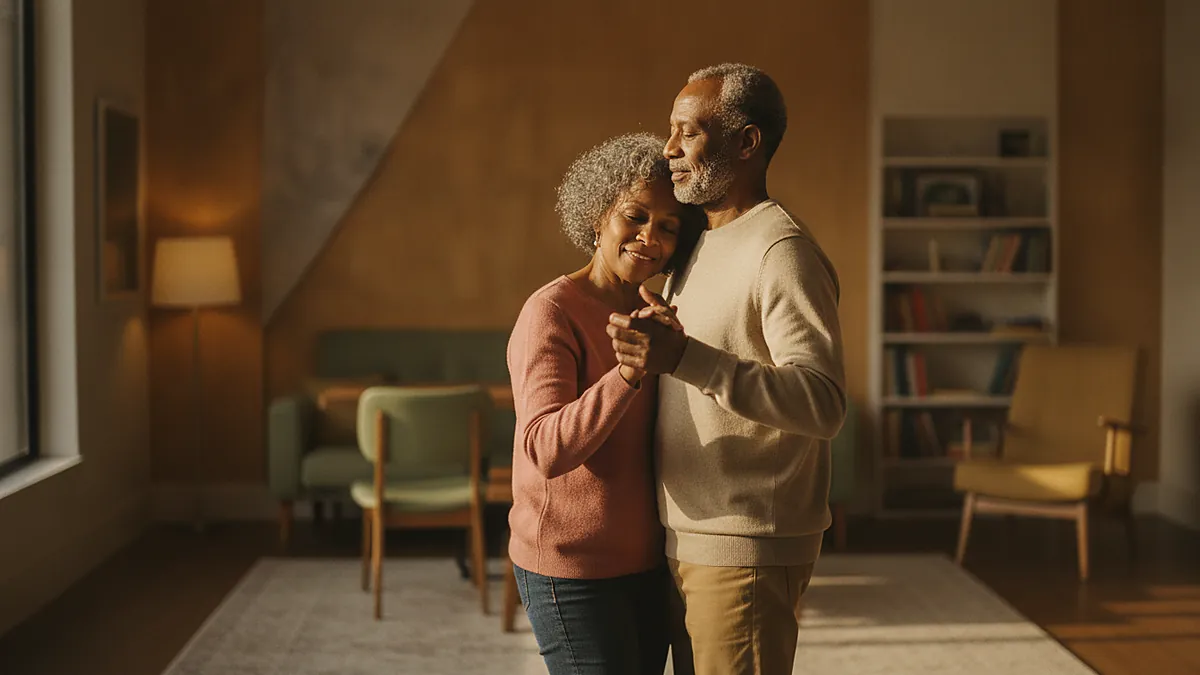
First, know that you’re in good company. Pew Research finds that about half of dating app users over 50 are looking for a long-term partner — these are serious people seeking real relationships, not a hookup economy you have to survive. Most of the people you’ll meet are exactly as nervous as you are, and hiding it exactly as badly.
Some things that help:
- Your timeline is yours. There is no required schedule. Anyone who pressures you on pace has failed an important test, and you should believe the result.
- Say the nervous part out loud. “I haven’t done this in a long time and I’m a little nervous” is disarming, honest, and — I can report — surprisingly attractive. Confidence after 50 isn’t pretending; it’s honesty delivered calmly.
- For the widowed: desire for a new person is not disloyalty to the one you lost. Grief and new love share space in the same heart without evicting each other. If guilt is heavy, a grief counselor is a genuinely good idea, not a dramatic one.
- New bodies, new conversation. You and a new partner get to build your own script rather than inheriting an old marriage’s silences. That’s not a burden. It’s the one real advantage of starting over.
If you’re rebuilding from scratch, our starting over guide walks through the first months step by step, and the broader intimacy hub covers what comes after this article. And if the relationship is new enough that you’re still deciding whether there’ll be a second date, start with the practical stuff in our first date tips for over 50.
When it’s time to talk to a doctor
We’re writers, not physicians, so this section is short and pointed: some changes are conversations for your partner, and some are conversations for your doctor. See a professional if you notice:
- Pain during sex. Common after menopause, very often treatable, never something to just endure.
- Erectile changes, especially sudden ones — partly because they can be an early signal of cardiovascular issues, which makes the appointment doubly worthwhile.
- A sudden drop in desire in either partner, particularly alongside a new medication or low mood.
- Anything that changed abruptly rather than gradually. Gradual is often aging; abrupt deserves a look.
Two things to hold onto. First, your doctor has this conversation constantly — you will not be the memorable patient. Second, an enormous amount of what people over 50 silently endure is treatable: lubricants and local estrogen, medication adjustments, ED treatments, pelvic floor therapy. Suffering quietly isn’t stoicism; it’s just missing out on solutions that exist. If raising it feels hard, write one sentence on your phone and read it in the exam room. Doctors respond well to directness, and you only have to be brave for ten seconds.
The same honesty applies at every stage of a relationship, by the way — the couples who talk about this at 55 are usually the ones who learned to talk about everything else first, which is most of what dating after 50 done well teaches you.
How often do older couples actually have sex? An honest answer
Less often than at 30, on average — and across a range so wide that no single number deserves to be called “normal.” That’s the honest answer, and I’d rather give it to you straight than invent a tidy frequency chart. What research on aging consistently shows, in broad strokes, is this: sexual activity generally declines with age, yet a meaningful share of adults remains sexually active well into their 70s and 80s, and interest in closeness doesn’t come with an expiration date. The University of Michigan/AARP National Poll on Healthy Aging found 40% of adults aged 65–80 sexually active — and 73% satisfied with their sex life, with 65% still interested.
So, to the questions people actually type into search bars: can a 70-year-old woman still be sexually active? Yes. Can a man in his 80s? Also yes. The real limiting factors are rarely age itself — they’re health, medications, having a partner at all, and whether the couple kept talking as things changed. Two 72-year-olds in good health with an easy rapport will often have more going on than a stressed, silent couple twenty years younger.
The more useful question than “how often is normal?” is “are we both roughly content?” A once-a-week couple and a once-a-season couple can be equally happy; a mismatch is a conversation, not a verdict. Two caveats worth flagging: if frequency fell off a cliff rather than a slope, or if the obstacle is pain or a physical change, that’s your cue to bring a doctor into it — those patterns often have specific, treatable causes, and guessing at them from the internet helps no one.
Medications, health conditions, and desire
A change in desire after 50 very often has a findable cause, and medications and health conditions are two of the most common — which is genuinely good news, because a cause you can name is frequently a cause that can be addressed. I say this as a writer, not a physician, so treat what follows as a map of what to ask about, not a diagnosis.
Some common threads worth raising with a doctor:
- Prescriptions. A number of widely used medications — including some blood pressure drugs and some antidepressants — list sexual side effects on the label. If a shift in desire or function showed up after a new prescription, that timing is worth mentioning to the prescriber. Never adjust or stop a medication on your own; alternatives and dosage changes often exist, but that’s a decision for the person who wrote the prescription.
- Chronic conditions. Diabetes, heart disease, chronic pain, and depression can all affect desire and function — sometimes directly, sometimes through fatigue or mood. Managing the condition well is often the intimacy strategy nobody mentions.
- Hormonal shifts. Menopause and declining testosterone change comfort, drive, and response for many people. How much, and what’s worth doing about it, varies enormously by person — which is exactly why it’s an appointment, not a search result.
The pattern to notice is change: gradual is often just aging, but a shift that’s abrupt or clearly linked to a new pill or diagnosis deserves a professional look. Bring the timeline to the appointment; doctors love a timeline.
The bottom line
Older couples sexuality is not a decline to be managed; it’s a renegotiation, and most couples who negotiate honestly end up somewhere good. The range of normal is vast, the changes are real but rarely the end of anything, and intimacy is a far bigger country than intercourse alone. Talk to your partner before the silence does the talking for you, and talk to a doctor when your body raises its hand. The couples who do best after 50 aren’t the luckiest ones — they’re the ones who kept the conversation going.
The figures above come from the National Poll on Healthy Aging and other primary research — we keep them, with methodology notes, in our statistics roundup and list every study we rely on on the sources page. Our editorial policy on evidence is spelled out on the editorial policy page; if a figure here looks wrong to you, contact us and we will check it.